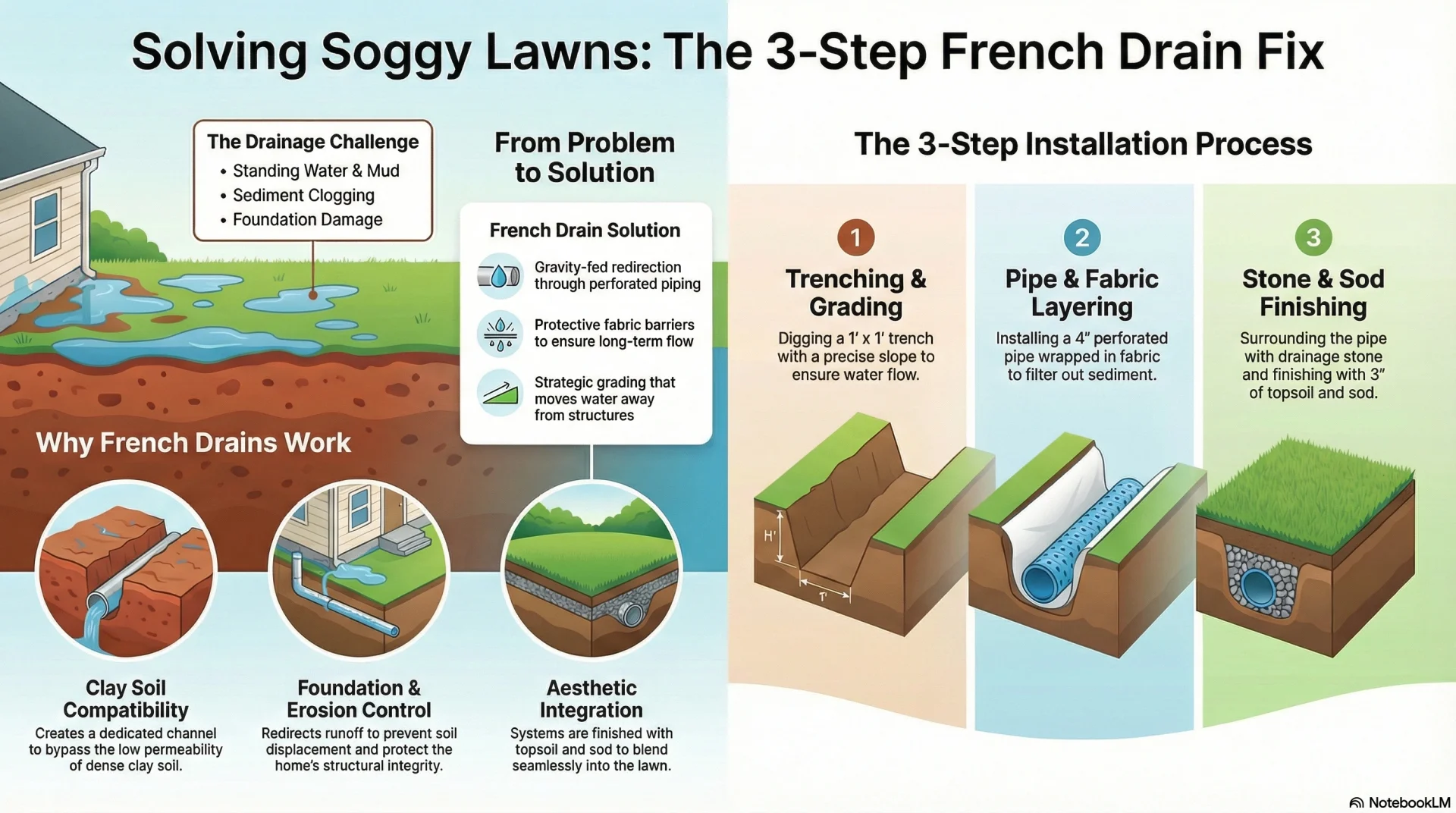
There’s nothing more frustrating than walking across your lawn weeks after the last rainfall only to find your shoes sinking into soggy ground. The grass struggles to survive, mud tracks into the house, and the backyard feels more like a swamp than a space to enjoy.
While a single heavy storm can temporarily overwhelm any yard, persistent water problems almost always point to something structural — not just the weather. Charlotte’s red clay soil, intense summer thunderstorms, and the grading practices of regional builders create a perfect storm of conditions that leave countless homeowners dealing with standing water they can’t explain or solve.
In this guide, we’ll break down the three main structural causes behind chronic backyard flooding and show you exactly how each one is fixed — before your lawn drowns for good. When you’re ready to stop guessing and get a professional set of eyes on your yard, CLT Pros offers free drainage assessments across the Charlotte metro area.
How Do You Know Your Yard Has a Drainage Problem?
Before diagnosing the cause, it helps to recognize the symptoms. Common signs that your Charlotte yard has a drainage issue include:
- Standing water that lingers for days after rain
- Soggy, spongy ground that never fully dries out
- Mud constantly tracked into the house from the backyard
- Grass that looks thin, patchy, or dead in low-lying areas
- Basement moisture, crawl space dampness, or foundation wall seepage
- Visible soil erosion or bare patches where water flows
- Mosquito populations concentrated in the backyard
If more than one of these applies to your property, the problem is likely structural — and surface-level fixes like adding topsoil or reseeding patchy grass will not solve it.
Main Cause #1: Poor Drainage Planning by Original Builders
Many Charlotte homeowners inherit water problems before they even move in. Original builders frequently treat lots as blank slates instead of accounting for slope, soil composition, and the natural path water wants to travel. This oversight creates drainage failures that become apparent only after the first few rainy seasons — long after the builder has moved on.
Compacted Soil from Heavy Equipment
During construction, heavy machinery compresses the ground to the point where it loses much of its ability to absorb rainfall. Where natural soil might accept several inches of water before runoff begins, compacted construction soil sheds water almost immediately. The result is surface pooling in areas that look flat and unremarkable but behave like a parking lot during heavy rain. Charlotte’s native clay soil makes this worse — it compacts easily and drains poorly even in its natural state.
Improper Downspout and Sump Pump Discharge
Gutters and sump pump discharge lines are often routed to dump water directly adjacent to the foundation or in the middle of the yard — nowhere near a storm drain or a safe outlet. Without proper extensions that carry water at least 6–10 feet from the house, every rainfall event deposits a concentrated stream of runoff right where it can do the most damage. Over time this saturates soil near the foundation and creates chronically wet zones that never dry out between storms.
Missing Subsurface Drainage Solutions
Lots with clay-heavy soil or naturally low-lying terrain need engineered drainage systems built in from the start — things like French drains or catch basins that intercept water before it pools. When these are skipped to save money during construction, there is simply no infrastructure in place to manage the water load during Charlotte’s frequent, intense summer storms.
The result is a backyard that begins its life unable to handle even moderate rainfall. Instead of draining, water collects and stagnates — leaving homeowners with a swampy yard that worsens every season.
The fix: A professional site assessment identifies which drainage infrastructure was skipped or inadequately installed. Solutions typically include French drain installation, downspout extensions piped to a safe outlet, and catch basins placed at low points. CLT Pros specializes in diagnosing exactly what the original builder missed and engineering a system to correct it. See all drainage services →
Main Cause #2: Poor Grading and Elevation Problems
When it comes to drainage, gravity should be your best ally. A properly graded yard uses slope to guide water away from structures and toward safe discharge points. But when grading was done poorly — or not at all — gravity becomes your enemy, directing water exactly where you don’t want it.
Negative Grade Toward the Foundation
One of the most dangerous and common grading mistakes in Charlotte-area homes is ground that slopes toward the house instead of away from it. Even a subtle inward slope of just 1–2% is enough to funnel hundreds of gallons of water toward the foundation during a heavy storm. Over time this leads to foundation cracks, basement moisture intrusion, and in severe cases, structural damage that costs far more to repair than proper grading ever would have.
Poorly Defined or Missing Swales
Swales are shallow, wide drainage channels designed to catch sheet flow and guide it off the property. They’re a standard part of proper site design but are frequently missing, too shallow to function, or incorrectly routed in many Charlotte neighborhoods. Berms — common in this area — are notorious for trapping water between the berm and the house rather than directing it away. Without a functional swale system, water has no pathway off the property and collects wherever the ground is lowest. CLT Pros installs swales and berms engineered to actually work with your property’s specific topography.
Inadequate Soil Movement and Contouring
Proper grading requires physically moving and reshaping soil to eliminate depressions and establish consistent slope. It’s not a process that can be approximated or eyeballed — the difference between a yard that drains and one that floods can be measured in fractions of an inch per foot. Without precision grading, rainwater collects in low spots and sits for days, suffocating grass roots and creating the damp, compacted conditions that mosquitoes and lawn disease love.
The fix: Professional regrading is the most direct solution to elevation-related drainage problems. CLT Pros’ grading and sloping service corrects negative grade, reshapes low spots, and re-establishes proper site drainage from the ground up. In many cases, a grading correction eliminates persistent flooding without any additional drain infrastructure required.
Main Cause #3: No or Clogged Drainage Systems
Even a yard with good grading still needs a functioning drainage system to handle heavy rain events — particularly in Charlotte, where summer thunderstorms can dump multiple inches of rain in a matter of hours. When that infrastructure is missing, poorly installed, or has deteriorated over time, the lawn has no defense against pooling water.
Systemic Absence of Drainage Solutions
Some properties — particularly those on clay-heavy soils or in low-lying areas — simply require engineered drainage systems to function properly. There is no amount of regrading that fully compensates for soil that cannot absorb water quickly enough. When no drainage infrastructure was ever installed, the yard is structurally unprepared for Charlotte’s rainfall patterns.
Clogged French Drains
French drains are among the most effective residential drainage tools available, but they require proper installation to work long-term. Over time, silt, fine soil particles, and invading tree roots can block the perforated pipe, stopping water from entering or exiting. A clogged French drain provides zero drainage benefit — it’s essentially a gravel-filled trench. Without periodic inspection and maintenance, French drains installed even a few years ago may be contributing nothing to your drainage system. CLT Pros installs French drains using proper filter fabric and quality materials designed to resist premature clogging.
Obstructed Catch Basins
Catch basins are only as useful as their grates are clear. Leaves, mulch, pine straw, and accumulated soil debris regularly clog basin grates — particularly in fall and after heavy storms. Once blocked, surface water has nowhere to go and simply backs up across the yard. Regular cleaning of catch basin grates is essential maintenance that many homeowners overlook until a flood event makes the problem impossible to ignore.
Cracked or Broken Pipes
Poor initial installation, settling soil, and invasive tree roots can all cause drain pipes to crack or separate at joints. Rather than carrying water safely away, a compromised pipe leaks underground — sometimes directly toward a foundation — creating hidden wet zones that saturate soil from below even when the surface looks dry. Identifying broken underground pipe requires a professional assessment; it cannot be diagnosed with a visual inspection of the yard alone.
The fix: CLT Pros’ drainage services cover the full spectrum — new French drain installation, catch basin installation and cleaning, downspout extension systems, channel drains for hardscaped surfaces, and complete stormwater system design. For properties with multiple overlapping issues, CLT Pros creates a comprehensive drainage plan that addresses every contributing factor together rather than treating symptoms one at a time.
Why Charlotte Yards Are Especially Vulnerable
Charlotte’s geography and climate create drainage challenges that are more severe than in many other parts of the country:
- Red clay soil: The dominant soil type across Mecklenburg, Union, and Cabarrus counties has very low permeability. It holds water rather than draining it, which means even a modest rain event can produce surface pooling that lingers for days.
- Intense summer thunderstorms: Charlotte regularly receives 2–4 inches of rain in a single storm during summer months. Even well-designed drainage systems can be temporarily overwhelmed; poorly designed ones simply fail.
- Rapid suburban development: Fast-paced construction across the Charlotte metro has left many properties with minimal drainage planning, compacted soils, and inadequate lot grading — problems that only become visible once a homeowner has lived through a few wet seasons.
- Berms and uneven terrain: Many Charlotte-area neighborhoods feature landscaped berms and rolling terrain that can redirect water from neighboring properties onto yours, compounding your own site’s drainage challenges.
Drainage Solutions That Actually Fix the Problem
Understanding the root cause determines which solution belongs on your property. CLT Pros offers the full range of professional drainage services needed to address any combination of the three root causes described above:
| Root Cause | Primary Solution(s) |
|---|---|
| Builder neglect / missing infrastructure | French drains, catch basins, downspout extensions |
| Poor grading / negative slope | Grading & regrading, swales & berms |
| Clogged or absent drain systems | French drain repair/replacement, catch basin installation, channel drains |
| Hardscape runoff (patios, driveways) | Channel drains, concrete curbing |
| Erosion on slopes | Erosion control, retaining walls |
Once drainage is resolved, many homeowners also find it’s the perfect time to address the lawn itself. Artificial turf installation pairs naturally with drainage work — eliminating the mud, dead patches, and maintenance that come with natural grass in chronically wet conditions.
Stop Treating Symptoms — Fix the Root Cause
Backyard drainage problems don’t happen by accident. They almost always stem from one of three root causes: poor planning during construction, improper grading that traps water, or clogged and missing drainage systems. Left unchecked, these issues turn your lawn into a swamp, put your foundation at risk, and create breeding grounds for mosquitoes that make the backyard unusable half the year.
Instead of endlessly reseeding soggy patches or piling on topsoil that washes away in the next storm, the right move is to diagnose the actual problem. A professional drainage assessment identifies whether your yard is suffering from builder oversight, elevation mistakes, or failing infrastructure — and maps out the exact fix required.
CLT Pros is a fully insured Charlotte-area contractor specializing in drainage, grading, hardscaping, and landscaping across Mecklenburg, Cabarrus, Gaston, Union, and York counties. We’ve helped homeowners throughout Charlotte, Fort Mill, Rock Hill, Concord, Indian Trail, Huntersville, and beyond reclaim their backyards from standing water.
📞 Call (704) 778-6755 — Mon–Sun, 7:00 AM – 7:00 PM
🗓️ Schedule your free drainage assessment online
Frequently Asked Questions: Backyard Drainage in Charlotte, NC
How much does it cost to fix yard drainage in Charlotte, NC?
Costs vary based on the solution required. A basic downspout extension system may run a few hundred dollars, while a full French drain installation for a typical Charlotte backyard generally ranges from $1,500 to $6,000+. Regrading projects vary widely based on how much soil needs to be moved. CLT Pros provides free, itemized estimates — request yours here.
How do I know if I need a French drain or just regrading?
If your yard slopes correctly but still pools water, you likely need a French drain or catch basin to intercept subsurface water. If the slope is the problem — water moves toward the house or collects in low spots — regrading addresses the root cause directly. Many Charlotte properties need both. A professional site visit is the only reliable way to determine the right solution for your specific yard.
Can standing water in my yard damage my foundation?
Yes. Soil that is chronically saturated near the foundation creates hydrostatic pressure against foundation walls, which over time causes cracks, moisture intrusion, and in severe cases structural damage. Addressing drainage problems early is significantly less expensive than foundation repair.
Does CLT Pros serve my area?
CLT Pros serves the full Charlotte metro area including Charlotte, Concord, Fort Mill, Rock Hill, Indian Trail, Waxhaw, Huntersville, Matthews, Mint Hill, Gastonia, Monroe, and surrounding communities. See the full service area map →
See it on a real job
Red clay is one of the most common reasons Charlotte-area yards flood. See how we graded a bare clay backyard, added drainage, and finished it with turf in our Weddington artificial turf and drainage project.